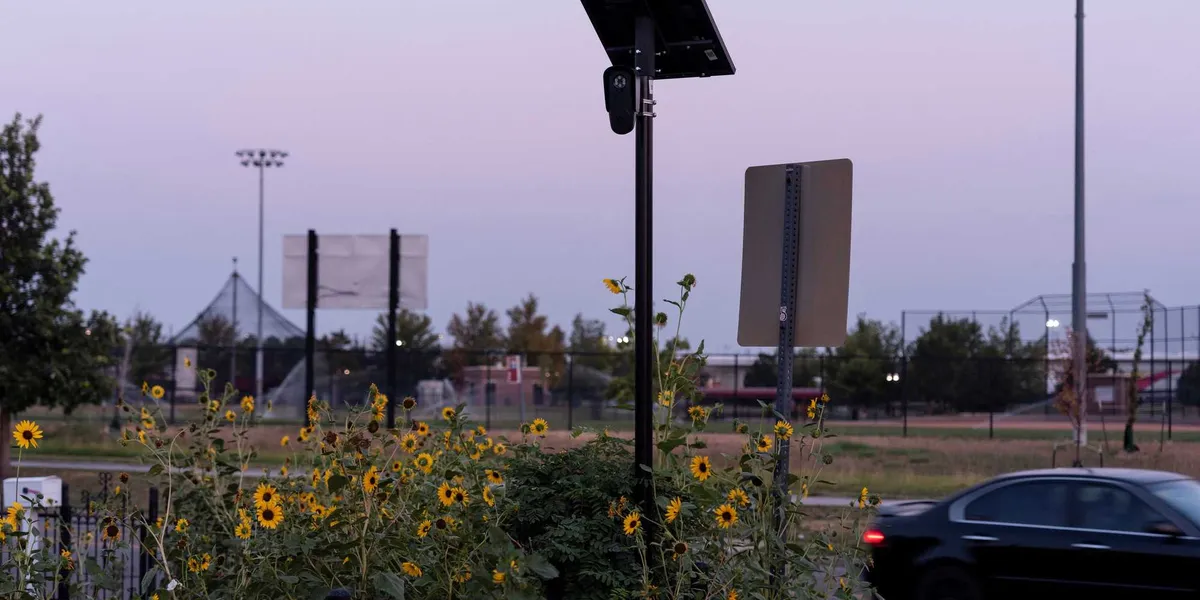
Flock Safety is tightening privacy and oversight controls for its nationwide network of automated license plate readers as more communities pull back from the technology and lawmakers across the political spectrum push for new restrictions.
Read more Rage erupts as Trump’s ‘foolish whims’ hit Navy with another ‘extraordinary’ cost
The company announced Thursday that it will recommend that police agencies retain license plate reader data for seven days, down from 30, while adding tools to restrict data sharing between agencies and detect potentially abusive searches. Flock also plans to require law enforcement users to associate searches with case codes and automatically suspend users whose activity is flagged as abnormal.
The changes come amid growing scrutiny of a surveillance network that Flock says has more than 120,000 cameras across 49 states and serves thousands of law enforcement agencies and communities.
The cameras photograph passing vehicles and record information including license plates, vehicle characteristics, location and time. Police can search the resulting data during investigations, sometimes across jurisdictional lines.
More than 50 agencies or communities have canceled, suspended or rejected a Flock contract or deactivated their cameras since the beginning of 2026, according to DeFlock, a grassroots group that tracks license plate reader deployments. Cameras have also been vandalized in communities around the country.
Recent incidents involving police officers accused of using Flock to track friends, relatives and romantic partners have added to concerns about how the data can be accessed and shared. The technology also has been criticized after inaccurate license plate information contributed to wrongful police stops, arrests and detentions.
Flock says the new measures will give communities greater control over their data while strengthening safeguards against misuse.
“These changes, like I said, are the next chapter of a long book I hope to write on how we build a better version of America that’s both safer, protects our privacy and holds those who have power accountable,” Flock Safety co-founder and CEO Garrett Langley said in a video statement.
But civil liberties advocates say some of the safeguards have been tried before and question whether the company’s changes address broader concerns about a system that can create a record of people’s movements even when they are not suspected of a crime.
States have taken different approaches to regulating technologies used in policing, including artificial intelligence, facial recognition, drones and automated license plate readers. More than a dozen states have enacted laws governing such technologies, according to the National Conference of State Legislatures, but there is no consistent national framework for their use.
Strengthening privacy and accountability
Flock’s seven-day retention recommendation is one of its most significant changes.
When the company launched nine years ago, it set 30 days as the default recommendation, while allowing communities to choose shorter or longer periods.
For investigations that require older information, Flock is introducing “Evidence Mode,” which will allow detectives to preserve specific license plate data as evidence in an active case.
The change does not automatically apply to existing customers, which can keep their current retention policies. Communities also will continue to choose their own retention periods.
The American Civil Liberties Union called the shorter retention period a potential step forward but said its impact will depend on how the new mode works. In a statement, the group recommended a 48-hour retention period and warned that if searches cause data to be preserved, the new system could allow significant amounts of location information to remain available longer than seven days.
Flock also is giving communities more control over which outside agencies can search their cameras. Under the new “offense filtering” system, a community could allow another agency to search its cameras for specific crimes or offenses and block searches related to immigration enforcement, for example.
Flock also will require all law enforcement customers to adopt its audit assistance tool by the end of the year. The system looks for unusual search activity and flags it for administrator review. Flock plans to automatically suspend users whose activity meets certain criteria for abnormal behavior while their access is reviewed.
The company also will require case codes for law enforcement searches by the end of the year. Officers can bypass the requirement during emergencies, but those searches also will be flagged for review.
Police misuse and erroneous alerts
Flock’s new controls build on safeguards the company has introduced in recent years, including electronic audit logs and requirements that users provide a reason for searches.
The ACLU, in its statement, said some of those earlier safeguards were ineffective. The group pointed to cases in which officers circumvented search-purpose restrictions by entering vague or meaningless explanations before Flock replaced a free-text field with a list of approved search reasons.
Read more Conservative judge rams brakes on Trump trucker project amid rage-fueled fight with states
The Washington Post reported earlier this month that nearly 50 police officers had been charged or accused of using Flock cameras for unauthorized purposes, many involving attempts to track current or former romantic partners or family members.
In Savannah, Georgia, four police officers and two civilian employees were fired last week after a department investigation found searches involving personal acquaintances and family members, according to a news release. The investigation also found that an officer had allowed an outside law enforcement agency to access Savannah’s Flock system.
The activity was identified using Flock’s audit assistance tool. All six cases were referred to the Georgia Bureau of Investigation for independent criminal investigations.
The technology has also drawn scrutiny when information in the system is inaccurate or outdated.
In Wisconsin, a woman was pulled over at gunpoint earlier this month after a Flock camera incorrectly flagged her vehicle as being involved in a homicide. Brookfield police stopped Amber Newell on Interstate 94 after receiving the alert, but Milwaukee police told officers they no longer needed the vehicle or its occupants. Newell was released.
Milwaukee police later said the incident was caused by an employee’s failure to remove an outdated wanted-vehicle alert from the Flock system, rather than an error by Flock itself. Newell said she had also been stopped at gunpoint earlier that week and was afraid to drive afterward.In its announcement, Flock said its alerts are intended to be investigative leads rather than conclusions and that officers should visually confirm a vehicle’s license plate before taking action. The company said its system produces fewer than nine human-reported errors for every 1 million alerts.
Bipartisan interest
A bipartisan group of Pennsylvania lawmakers announced Monday that they plan to introduce legislation establishing statewide privacy and accountability requirements for automated license plate readers, including Flock cameras.
The proposal would establish rules governing access to the data, documented reasons for searches, audit trails, data retention and transparency. It also would create civil penalties for unauthorized access, use or disclosure and allow people harmed by misuse to bring civil suits.
“Technology that can help keep our communities safe should never become a tool for stalking or abuse,” Democratic state Rep. Jennifer O’Mara said in a statement announcing the proposal.
Republicans in Congress also have introduced or plan to introduce at least two proposals aimed at restricting automated surveillance technology. One would restrict federal agencies from purchasing or using certain automated surveillance technology, while the other would bar state and local police from using federal funds to acquire automated license plate reader systems.
Last month, 15 Democratic lawmakers in Michigan sent a letter to the state Department of Transportation to end an agreement allowing federal agencies, including U.S. Border Patrol and Homeland Security Investigations, to install surveillance technology on state property. The lawmakers argued that automated license plate readers infringe on residents’ constitutional rights.
The West Virginia House Democratic Caucus also released a statement last month opposing Flock cameras and said it is monitoring canceled contracts and lawsuits involving the technology.
Abandoning the technology
Some local governments are going further by ending their relationships with Flock altogether.
DeFlock’s tracker lists dozens of communities that have canceled contracts, deactivated cameras or rejected proposals since 2021.
More than 50 agencies or communities have taken one of those steps since the beginning of 2026.
Several communities in Rhode Island and Nebraska have acted this month, with city leaders voting to cancel contracts or uninstall cameras.
Earlier this month, the Burnet County Sheriff’s Office in Texas announced that it had removed all fixed Flock cameras after repeated vandalism damaged the equipment. The cameras were provided by the Heart of Texas Auto Theft Task Force, a multi-agency, multijurisdictional task force in Central Texas. The sheriff’s office has initiated criminal cases, but there are currently no suspects, according to a news release.
The debate over this technology is likely to continue through the rest of the year and into 2027, when more state legislatures return to session. That could bring additional proposals to regulate artificial intelligence tools used in policing, as well as how license plate reader data is collected, retained, shared and used.
Stateline reporter Amanda Watford can be reached at [email protected].
This story was originally produced by Stateline, which is part of States Newsroom, a nonprofit news network which includes Louisiana Illuminator, and is supported by grants and a coalition of donors as a 501c(3) public charity.
Read more MAGA rep exposed for ‘cynical’ plot behind ‘deranged’ outbursts: ‘Chooses to red-pill’