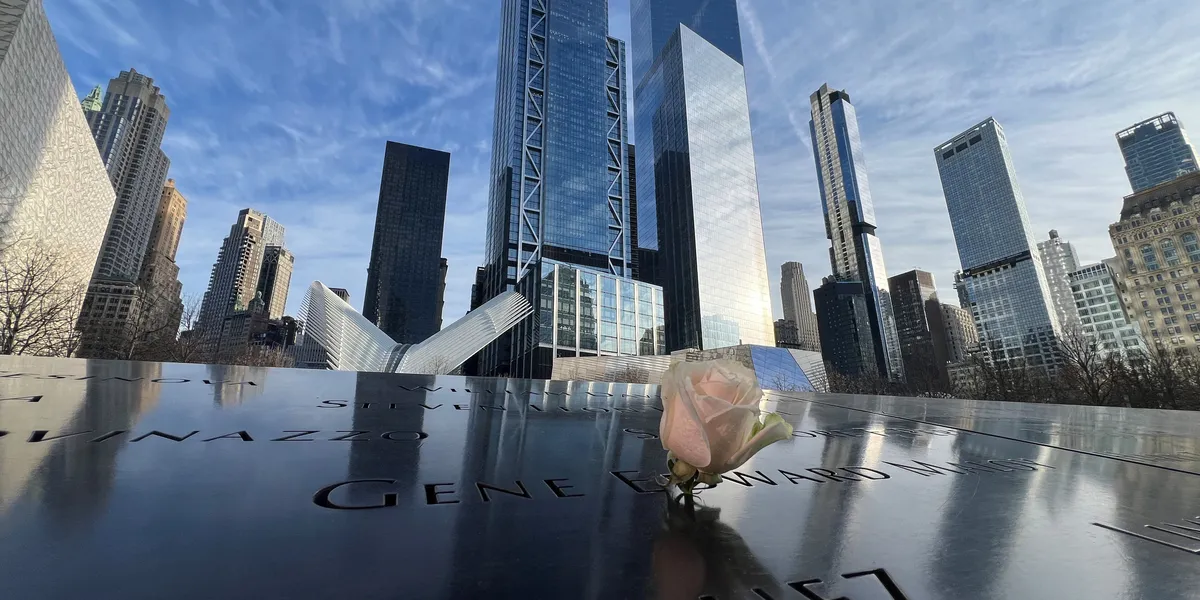
A military judge ruled that confessions that alleged 9/11 mastermind Khalid Shaikh Mohammed gave to FBI agents cannot be used against him at trial, dealing a major setback to the government’s death-penalty case over the Sept. 11 attacks.
Read more Tetchy Trump tries to clean up Reflecting Pool mess with bold ‘American Flag Blue’ claim
The New York Times reported that Friday’s ruling comes just before the 25th anniversary of the attacks and could further delay a trial prosecutors have already scheduled for June 5, 2028, if they choose to appeal.
Prosecutors had described Mohammed’s 2007 interrogations at Guantánamo Bay as the government’s most crucial evidence in the long-running case.
The accused of masterminding the hijackings that killed nearly 3,000 people was subjected to brutal CIA interrogations in secret overseas prisons after his 2003 capture and held incommunicado until his 2006 transfer to Guantánamo.
Prosecutors had already excluded statements from those earlier interrogations, but the trial judge, Lt. Col. Michael Schrama, went further, ruling that Mohammed’s subsequent 2007 FBI interrogations were also inadmissible, writing that “the prosecution has failed to prove by a preponderance of the evidence that Mr. Mohammad’s statements to the F.B.I. were voluntarily given,” according to the Times, which cited lawyers who had reviewed the 45-page ruling.
Schrama cited an “unbroken continuation” of CIA psychological conditioning and coercion at the time of the 2007 questioning, and found FBI agents had intentionally failed to explicitly inform Mohammed of his rights to remain silent and consult a lawyer.
Read more Trump admin’s document dump to right-wingers accidentally reveals secret DHS hire: report
The ruling is the latest in a series of setbacks tied to the case’s torture allegations.
Schrama has not yet ruled on confessions from two co-defendants, Walid bin Attash and Mustafa al-Hawsawi.
A previous judge threw out the confession of Mohammed’s nephew, Ammar al-Baluchi, and another judge suppressed the confession of Abd al-Rahim al-Nashiri in the separate USS Cole bombing case after finding he had been tortured; that case is set for trial in October.
The Sept. 11 case has remained in pretrial proceedings since Mohammed’s 2012 arraignment, with survivors and victims’ families expressing concern they may never see it resolved.
Read more Obama-appointed judge takes ‘satisfying slap’ at Supreme Court over Trump: analysis