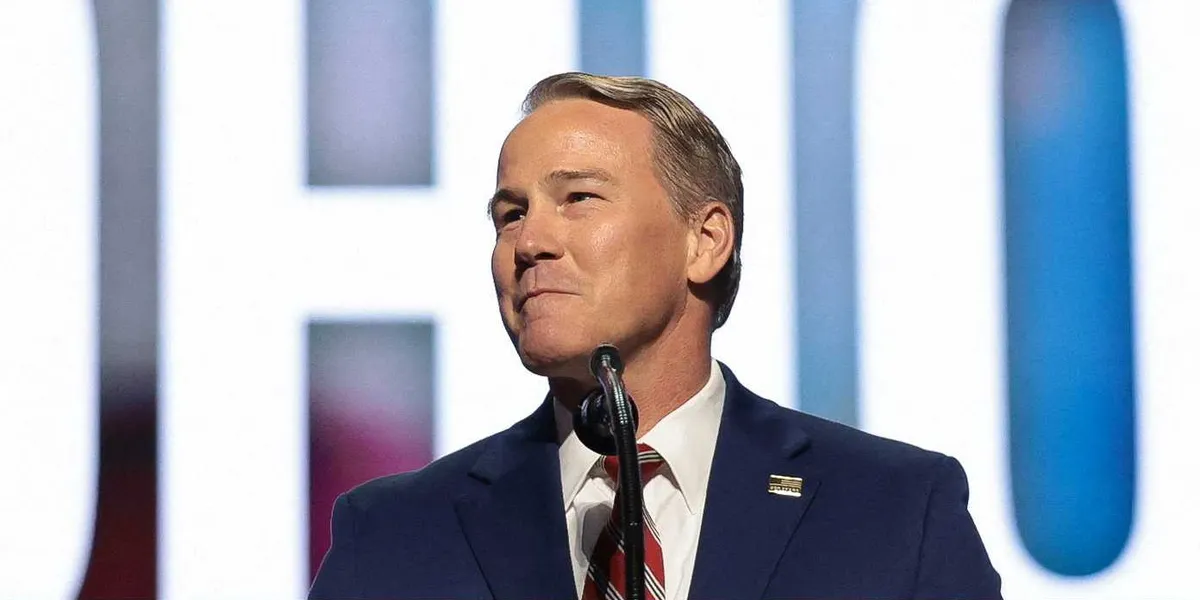
In 2022, then-Lt. Gov. Jon Husted stirred controversy when he joined the board of a regional bank.
Read more Fears grow that Trump boys are about to cut and run and hang their investors out to dry
He already had two official jobs with the state that paid $176,000.
Why, critics asked, did he need another? And, because the executive branch he was part of regulates such banks, did he have a potential conflict of interest?
Husted said he would recuse himself from any conflicts. He also told the Capital Journal that the gig wouldn’t pay much, about $20,000 a year.
He explained that it was a learning opportunity; a chance to see from the inside how a regional bank helps Ohio communities by doing things like lending to farmers and small businesses.
What he didn’t say was that the bank would become a source of political money for him.
Campaign disclosures show that Heartland Bank gave $492,000 to Husted’s political committee, Jon Husted for Ohio, after he joined its board of directors. The contributions continued after Gov. Mike DeWine appointed Husted in 2025 to the U.S. Senate and at least until June 30, when Heartland gave the committee $15,000, records from the Ohio Secretary of State’s office show.
Husted’s financial disclosures also show that, as of last year, he and his wife had at least $250,000 on deposit in the bank and at least $16,000 invested in its successor company’s stock.
Husted’s office didn’t respond to questions for this story.
But Paul Nick, executive director of the Ohio Ethics Commission, said it isn’t a violation of state ethics law for an official like Husted to receive such campaign contributions.
“There is an exception in the conflict of interest law that is relevant to your question,” Nick said in an email. “R.C. 102.03(G) states that campaign contributions are not a thing of value for purposes of the Ethics Laws, unless there is evidence that it was a bribe, other criminal offense, or made with purpose to commit a fraud.”
Catherine Turcer of voting rights advocacy group Common Cause Ohio said it’s naive to think businesses aren’t buying access when they make big political donations.
“We act like it’s Kabuki theater when it comes to campaign contributions,” she told the Capital Journal. “It’s nearly legalized bribery. People who are paying attention know that.”
Real-life experience
Husted joined the board of Heartland Bank after he had been lieutenant governor for about three years.
In addition to being No. 2 in the DeWine administration, Husted headed up InnovateOhio, a public-private sector board tasked with making state government more efficient. DeWine created the agency shortly after becoming governor in 2019.
After Husted joined the bank’s board, he said he only expected to be paid about $20,000 a year for his efforts. But he said the experience would be invaluable to him as a public official.
“What you do at a community bank is very micro issues,” he told the Capital Journal in July 2022. “It’s loans for people’s automobiles, it’s farmers who borrow money, it’s restaurants and businesses who need capital. It’s a great opportunity for me to learn about all that, and for many years it’s something that I’ve wanted to do but just never really could prioritize it.”
He added, “I only intend on doing it for a couple of years to get the experience, to get the understanding, and that’s why I did it. I think it’s a great educational experience and I would recommend it to any policymaker.”
Husted said he would declare any potential conflicts of interest and would recuse himself when he did.
He stayed on the bank’s board until early 2025, when DeWine appointed him to the U.S. Senate seat vacated by now-Vice President JD Vance. As that happened, Heartland Bank merged with Jasper, Ind.-based German American Bank, which didn’t respond to requests for comment.
Read more ‘Jaw-dropping’: Gasps as bombshell report reveals who paid for Don Jr’s glitzy wedding
Husted personally received a $57,000 “forced payout” on restricted stock as a consequence of the merger, his 2025 Senate financial disclosure shows. The same disclosure shows that Husted and his wife had between $250,000 and $500,000 in Heartland bank as well as $16,000 to $30,000 worth of stock in what is now German American Bancorp, Heartland’s new parent company.
The DeWine administration didn’t sign off on the merger, however.
If the bank that resulted from it were chartered in Ohio it would have needed approval by the state Department of Commerce’s Division of Financial Institutions. However, a spokeswoman said, it was chartered in Indiana, so Ohio regulators didn’t need to approve it.
In addition, the Capital Journal filed a public records request for copies of any written communications regarding Heartland Bank between Husted or his staff and the Division of Financial Institutions, to see if Husted and his staff were writing to regulators about the merger or other bank business.
The Division of Financial Institutions said there were none.
Ethical questions large and small
The Capital Journal found no documentary evidence that Husted violated his pledge to avoid conflicts. But he and many others in the DeWine administration have faced a number of potential conflicts and other ethical questions over the years.
For example, as a state lawmaker, Husted protected the funding and fought against greater scrutiny of the Electronic Classroom of Tomorrow, an online charter school that gave him $36,000 in campaign donations.
The school imploded starting in 2016 as investigations showed it had one of the highest dropout rates in the country.
The school also couldn’t show that its tens of thousands of students were doing anything more than logging onto their computers once a day. By that time, taxpayers had sunk more than $1 billion into the scheme, which was originally drawn up on a Waffle House napkin.
In addition, Husted supported Ohio House Bill 6, a $1.3 billion FirstEnergy bailout that resulted in a federal investigation and the arrest of five prominent Ohio Republicans.
Both Husted and DeWine, who signed the bill into law, said they were unaware of the $61 million in dark-money bribes that made it possible. But several senior officials in the administration were former FirstEnergy employees and one set up one of the main dark-money groups that funded the scheme.
A federal prosecutor said the scheme was likely the biggest bribery scandal in Ohio history. Litigation over it revealed internal documents saying FirstEnergy executives secretly funneled a $1 million donation through another dark-money group to the “Husted campaign” in 2017.
The contribution was made to an independent group, and Husted’s spokeswoman told the Cleveland Plain Dealer that his campaign wasn’t affiliated with it. She didn’t answer other questions.
Husted’s committee continued to receive Heartland Bank’s money as his administration made Josh Rubin, an Intel lobbyist, head of Ohio’s “private” economic development authority.
That was after the authority, JobsOhio, and the state had committed billions to a massive Intel chip plant that is now far behind schedule. Intel continued to pay Rubin to lobby the state since his 2023 appointment.
In addition, Husted’s wife was invested in Intel stock even though he has used his official positions to communicate with company officials and other insiders. Press accounts show Husted received information about the project that wasn’t widely known.
Turcer of Common Cause said it’s important to raise red flags when officials have potential conflicts. That keeps small scandals from growing into big ones, she said.
“What’s important about keeping government work separate from corporate work is to make sure a government official is paying attention to the needs of Ohioans,” she said of the Heartland Bank contributions to Husted’s political committee. “Is this a scandal like House Bill 6? No. But we can learn a lot about a culture of corruption in Ohio from things like this. It’s not a lot to ask that state elected officials — like the lieutenant governor — focus only on the state of Ohio and the folks who put him in office.”
Ohio Capital Journal is part of States Newsroom, a nonprofit news network supported by grants and a coalition of donors as a 501c(3) public charity. Ohio Capital Journal maintains editorial independence. Contact Editor David Dewitt for questions: [email protected].
Read more Fetterman kept his staff in the dark on jarring GOP-engineered convention cameo: report