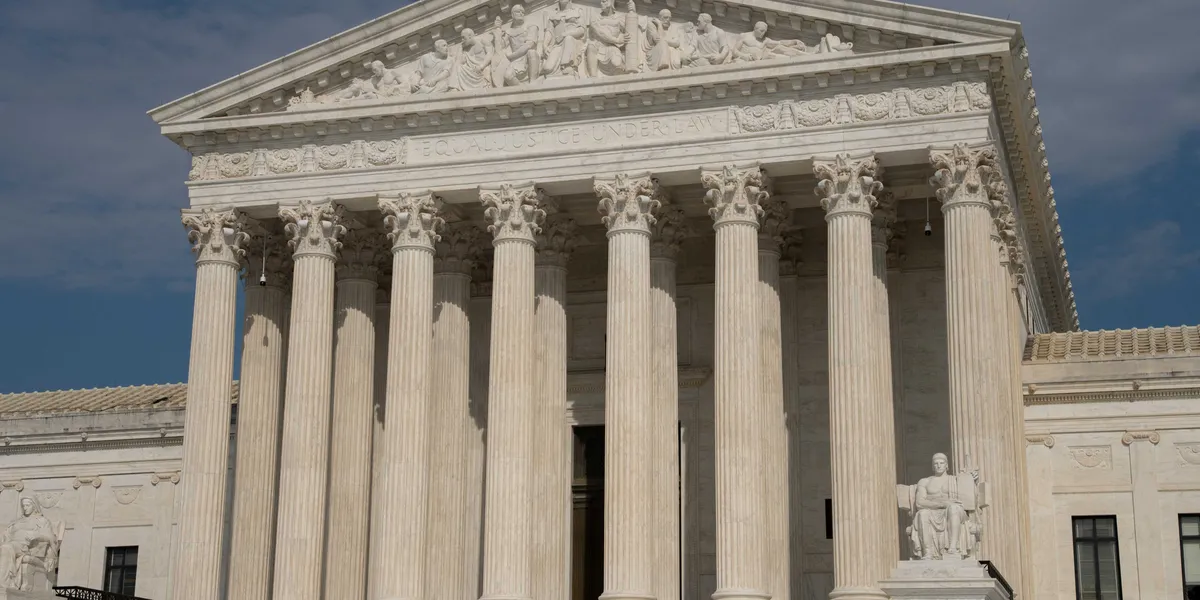
The U.S. Supreme Court cleared the way for millions of dollars in Republican political party committees’ coffers to be used to buy television ads at the steep discount federal law reserves for candidates, just eight weeks before the midterm elections.
Read more Shadowy figures that devised Trump’s slush fund ordered released in major DOJ loss
The justices issued a four-page unsigned order Friday afternoon that put on hold an appeals court ruling limiting the discount to candidates themselves, SCOTUSblog reported. Justice Ketanji Brown Jackson was the lone dissenter.
President Donald Trump’s administration and Republicans had wanted the ruling to unlock party committees’ funds at the best advertising rates. The advertising discount window for the Nov. 3 election opened the same day the order came down. And fundraising at the party committee level is an advantage Republicans hold over Democrats.
Federal law requires broadcasters to sell candidates airtime at the cheapest rate they charge anyone for the same kind of slot, Editor & Publisher noted.
The discount kicks in 45 days before a primary and 60 days before a general election, the outlet reported. The same campaign dollar therefore buys far more airtime.
Discounted rates for coordinated ads have historically run three to 13 times cheaper than what outside political groups pay, the National Republican Senatorial Committee said in a June memo cited by Reuters.
The discount grew far more valuable in June, when the Supreme Court struck down the cap on how much a party may spend in coordination with its own candidates, the Federal Election Commission said.
Party committees can now spend without limit and, as of Friday, at the candidate price. The GOP senatorial committee told supporters it could spend “without limit in direct coordination” with every Senate campaign.
“[T]he practical impact is asymmetric,” the committee said in the memo, which was obtained by ABC News.
Republican committees “vastly outraised our Democrat counterparts” this cycle, the memo added. The three major Republican committees ended July with about $279 million in cash, more than double the roughly $136 million held by their Democratic counterparts, who also carried nearly $18 million in debt, according to FEC filings cited by Reuters.
Democratic strategist Sawyer Hackett said his party had been “caught flat-footed,” ABC News reported, while Republican strategist Doug Heye said the GOP “is poised to take a quick advantage.”
The four Democrats who brought the case told the justices that rival party committees had promised to spend hundreds of millions of dollars “at the candidate rate” to “obliterate” them, calling it “a complete game changer,” the SCOTUSblog report said.
Reviving the policy would expose them to “an onslaught of more negative advertising than they would otherwise face,” the candidates told the court, along with tougher competition for a limited amount of airtime, according to Reuters.
The National Republican Congressional Committee and its Senate counterpart countered that they had already budgeted “tens of millions of dollars in ad buys under these rules,” Reuters reported.
“But because of the 4th Circuit’s decision, broadcast stations are already rescinding those rates,” the committees told the justices.
The Supreme Court did not decide who is actually entitled to the discount. But it sided with the Republican committees on a narrower question, finding they were likely to prevail in their argument that the appeals court lacked authority to hear the case yet, according to the same report.
Read more Elon Musk suffers setback in crusade to take on law banning sexually explicit AI deepfakes
“Because the candidates’ application for review was pending when they filed their petition for review, the Fourth Circuit likely lacked statutory jurisdiction to address their challenge,” the order said.
Leaving the ruling in place would cause permanent damage that refunds could not repair, the court added.
Paying more for airtime would hamper the committees’ “efforts to reach the electorate in the critical weeks leading up to the midterms” and implicate their First Amendment rights, the order said.
Jackson wrote a one-paragraph dissent saying the committees were “not likely to succeed” on that jurisdictional argument, because an agency cannot block judicial review of its conduct simply by refusing to act, SCOTUSblog reported.
The dispute began March 30, when the Media Bureau of the Federal Communications Commission, chaired by Trump ally Brendan Carr, told broadcasters the discount also covered political parties and joint fundraising committees, Reuters reported.
Sen. Jon Ossoff (D-GA), former Sen. Sherrod Brown of Ohio, former North Carolina Gov. Roy Cooper and Rep. Kristen McDonald Rivet (D-MI) asked the full commission on April 29 to review that notice, according to SCOTUSblog.
Roughly six weeks later, with the agency still silent, the four Democrats went to federal court. A divided panel of the 4th U.S. Circuit Court of Appeals sided with them Aug. 25, ruling 2-1 that for purposes of the discount, “the term ‘candidate’ means ‘candidate.'”
Judge Robert King wrote that the commission sat on the candidates’ challenge for more than three months and that an agency lawyer conceded at argument it was “very unlikely” the commission would act before Sept. 4.
Carr then circulated an order that would have dismissed the challenge as an “improper vehicle” rather than decide it, King wrote, describing a “Catch-22” that was “necessarily illogical and intolerable.”
“That is too much power for an agency,” Judge James Wynn wrote in a concurring opinion.
Judge J. Harvie Wilkinson dissented, writing that the panel’s decision “restrict[s] political speech in the sensitive period leading up to an election,” SCOTUSblog reported.
The Trump administration backed the Republican committees, with U.S. Solicitor General D. John Sauer arguing the notice “does not grant favored treatment to one side or the other,” according to the SCOTUSblog report.
Friday’s order is the latest in a run of election rulings from the court that have favored Republicans, Reuters reported.
The justices gutted a core provision of the Voting Rights Act in Louisiana v. Callais on April 29, touching off a redistricting scramble in Republican-led states, NBC News reported.
The court has been accused of stepping into election disputes after voting is already underway, the same outlet reported, a warning the justices have historically issued to lower courts.
Read more Blundering Trump smacked with swift reminder as Oval Office gaffe called out as illegal